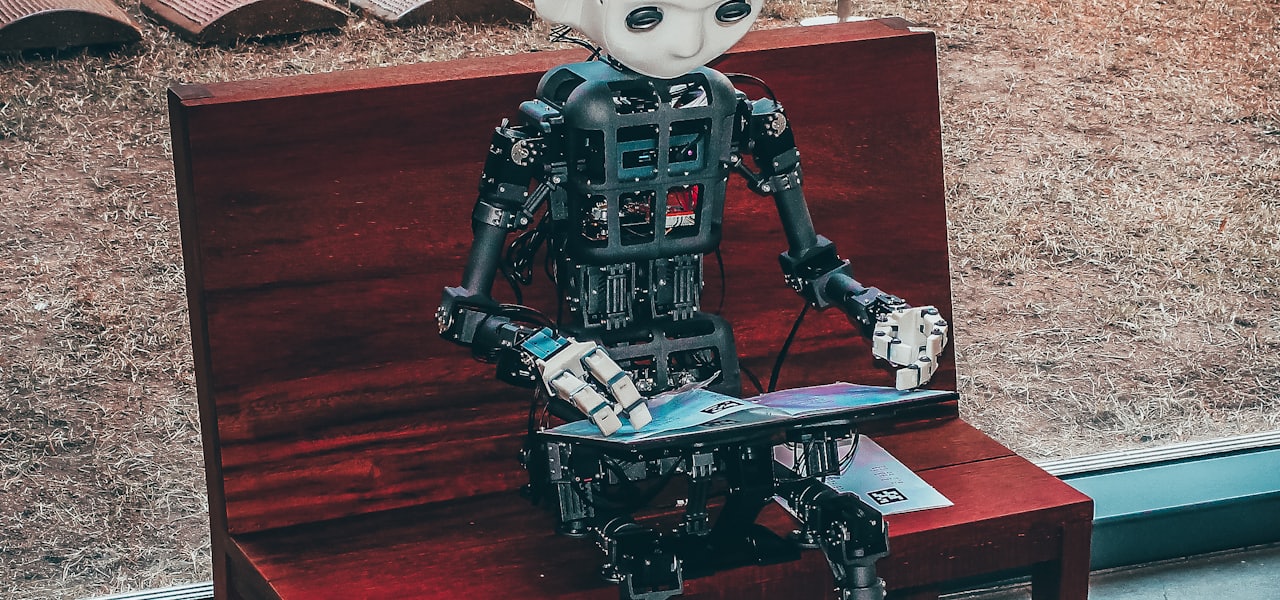
Artificial psychology (AP) has had multiple meanings dating back to 19th century, with recent usage related to artificial intelligence (AI).Artificial psychology is a theoretical field related to artificial intelligence, cognitive science, and psychology, which explores how advanced AI systems may develop human-like decision-making processes. In 1999, Zhiliang Wang and Lun Xie presented a theory of artificial psychology based on artificial intelligence. They analyze human psychology using information science research methods and artificial intelligence research to probe deeper into the human mind. == Main Theory == Dan Curtis (b. 1963) proposed AP is a theoretical discipline. The theory considers the situation when an artificial intelligence approaches the level of complexity where the intelligence meets two conditions: Condition I A: Makes all of its decisions autonomously B: Is capable of making decisions based on information that is New Abstract Incomplete C: The artificial intelligence is capable of reprogramming itself based on the new data, allowing it to evolve. D: And is capable of resolving its own programming conflicts, even in the presence of incomplete data. This means that the intelligence autonomously makes value-based decisions, referring to values that the intelligence has created for itself. Condition II All four criteria are met in situations that are not part of the original operating program When both conditions are met, then, according to this theory, the possibility exists that the intelligence will reach irrational conclusions based on real or created information. At this point, the criteria are met for intervention which will not necessarily be resolved by simple re-coding of processes due to extraordinarily complex nature of the codebase itself; but rather a discussion with the intelligence in a format which more closely resembles classical (human) psychology. If the intelligence cannot be reprogrammed by directly inputting new code, but requires the intelligence to reprogram itself through a process of analysis and decision based on information provided by a human, in order for it to overcome behavior which is inconsistent with the machines purpose or ability to function normally, then artificial psychology is by definition, what is required. The level of complexity that is required before these thresholds are met is currently a subject of extensive debate. The theory of artificial psychology does not address the specifics of what those levels may be, but only that the level is sufficiently complex that the intelligence cannot simply be recoded by a software developer, and therefore dysfunctionality must be addressed through the same processes that humans must go through to address their own dysfunctionalities. Along the same lines, artificial psychology does not address the question of whether or not the intelligence is conscious. As of 2022, the level of artificial intelligence does not approach any threshold where any of the theories or principles of artificial psychology can even be tested, and therefore, artificial psychology remains a largely theoretical discipline. Even at a theoretical level, artificial psychology remains an advanced stage of artificial intelligence.
Fuse Mediation Router
Fuse Mediation Router is an open source tool for integrating services using Enterprise Integration Patterns based on Apache Camel for use in enterprise IT organizations. It is certified, productized and fully supported by the people who wrote the code. Fuse Mediation Router uses a standard method of notation to go from diagram to implementation without coding. Fuse Mediation Router is a rule-based routing and process mediation engine that combines the ease of basic POJO development with the clarity of the standard Enterprise Integration Patterns. It can be deployed inside any container or be used stand-alone, and works directly with any kind of transport or messaging model to rapidly integrate existing services and applications. Fuse Mediation Router is now a part of Red Hat JBoss Fuse. == Tooling == FuseSource offers graphical, Eclipse-based tooling for Apache Camel for download.
Local coordinates
Local coordinates are the ones used in a local coordinate system or a local coordinate space. Simple examples: Houses. In order to work in a house construction, the measurements are referred to a control arbitrary point that will allow to check it: stick/sticks on the ground, steel bar, nails... Addresses. Using house numbers to locate a house on a street; the street is a local coordinate system within a larger system composed of city townships, states, countries, postal codes, etc. Local systems exist for convenience. On ancient times, every work was made on relative bases as there was no conception of global systems. Practically, it is better to use local systems for small works as houses, buildings... For most of the applications, it is desired the position of one element relative to one building or location, and in a more local way, relative to one furniture or person. In a regular way, you will not give your position by geographical coordinates rather than "I am 15 meters away of the entry to the building". So it is a pretty common way to locate things. It is possible to bring latitude and longitude for all terrestrial locations, but unless one has a highly precise GPS device or you make astronomical observations, this is impractical. It is much simpler to use a tape, a rope, a chain... The position information (global) should be transformed into a location. Position refers to a numeric or symbolic description within a spatial reference system, whereas location refers to information about surrounding objects and their interrelationships. (Topological space) == Use == In computer graphics and computer animation, local coordinate spaces are also useful for their ability to model independently transformable aspects of geometrical scene graphs. When modeling a car, for example, it is desirable to describe the center of each wheel with respect to the car's coordinate system, but then specify the shape of each wheel in separate local spaces centered about these points. This way, the information describing each wheel can be simply duplicated four times, and independent transformations (e.g., steering rotation) can be similarly effected. Bounding volumes of objects may be described more accurately using extents in the local coordinates, (i.e. an object oriented bounding box, contrasted with the simpler axis aligned bounding box). The trade-off for this flexibility is additional computational cost: the rendering system must access the higher-level coordinate system of the car and combine it with the space of each wheel in order to draw everything in its proper place. Local coordinates also afford digital designers a means around the finite limits of numerical representation. The tread marks on a tire, for example, can be described using millimeters by allowing the whole tire to occupy the entire range of numeric precision available. The larger aspects of the car, such as its frame, might be described in centimeters, and the terrain that the car travels on could be specified in meters. In differential topology, local coordinates on a manifold are defined by means of an atlas of charts. The basic idea behind coordinate charts is that each small patch of a manifold can be endowed with a set of local coordinates. These are collected together into an atlas, and stitched together in such a way that they are self-consistent on the manifold. In Cartography and Maps, the traditional way of works are local datum. With a local datum the land can be mapped on relative small areas as a country. With the need of global systems, the transformations on between datum became a problem, so geodetic datum have been created. More than 150 local datum have been used in the world.
Database-as-IPC
In computer programming, Database-as-IPC may be considered an anti-pattern where a disk persisted table in a database is used as the message queue store for routine inter-process communication (IPC) or subscribed data processing. If database performance is of concern, alternatives include sockets, network socket, or message queue. British computer scientist, Junade Ali, defined the Database-as-IPC Anti-Pattern as using a database to "schedule jobs or queue up tasks to be completed", noting that this anti-pattern centres around using a database for temporary messages instead of persistent data. == Controversy == The issue arises if there is a performance issue, and if additional systems (and servers) can be justified. In terms of performance, recent advancements in database systems provide more efficient mechanisms for signaling and messaging, and database systems also support memory (non-persisted) tables. There are databases with built-in notification mechanisms, such as PostgreSQL, SQL Server, and Oracle. These mechanisms and future improvements of database systems can make queuing much more efficient and avoid the need to set up a separate signaling or messaging queue system along with the server and management overhead. While MySQL doesn't have direct support for notifications, some workarounds are possible. However, they would be seen as non-standard and therefore more difficult to maintain.
Snapshot isolation
In databases, and transaction processing (transaction management), snapshot isolation is a guarantee that all reads made in a transaction will see a consistent snapshot of the database (in practice it reads the last committed values that existed at the time it started), and the transaction itself will successfully commit only if no updates it has made conflict with any concurrent updates made since that snapshot. Snapshot isolation has been adopted by several major database management systems, such as InterBase, Firebird, Oracle, MySQL, PostgreSQL, SQL Anywhere, MongoDB and Microsoft SQL Server (2005 and later). The main reason for its adoption is that it allows better performance than serializability, yet still avoids most of the concurrency anomalies that serializability avoids (but not all). In practice snapshot isolation is implemented within multiversion concurrency control (MVCC), where generational values of each data item (versions) are maintained: MVCC is a common way to increase concurrency and performance by generating a new version of a database object each time the object is written, and allowing transactions' read operations of several last relevant versions (of each object). Snapshot isolation has been used to criticize the ANSI SQL-92 standard's definition of isolation levels, as it exhibits none of the "anomalies" that the SQL standard prohibited, yet is not serializable (the anomaly-free isolation level defined by ANSI). In spite of its distinction from serializability, snapshot isolation is sometimes referred to as serializable by Oracle. == Definition == A transaction executing under snapshot isolation appears to operate on a personal snapshot of the database, taken at the start of the transaction. When the transaction concludes, it will successfully commit only if the values updated by the transaction have not been changed externally since the snapshot was taken. Such a write–write conflict will cause the transaction to abort. In a write skew anomaly, two transactions (T1 and T2) concurrently read an overlapping data set (e.g. values V1 and V2), concurrently make disjoint updates (e.g. T1 updates V1, T2 updates V2), and finally concurrently commit, neither having seen the update performed by the other. Were the system serializable, such an anomaly would be impossible, as either T1 or T2 would have to occur "first", and be visible to the other. In contrast, snapshot isolation permits write skew anomalies. As a concrete example, imagine V1 and V2 are two balances held by a single person, Phil. The bank will allow either V1 or V2 to run a deficit, provided the total held in both is never negative (i.e. V1 + V2 ≥ 0). Both balances are currently $100. Phil initiates two transactions concurrently, T1 withdrawing $200 from V1, and T2 withdrawing $200 from V2. If the database guaranteed serializable transactions, the simplest way of coding T1 is to deduct $200 from V1, and then verify that V1 + V2 ≥ 0 still holds, aborting if not. T2 similarly deducts $200 from V2 and then verifies V1 + V2 ≥ 0. Since the transactions must serialize, either T1 happens first, leaving V1 = −$100, V2 = $100, and preventing T2 from succeeding (since V1 + (V2 − $200) is now −$200), or T2 happens first and similarly prevents T1 from committing. If the database is under snapshot isolation(MVCC), however, T1 and T2 operate on private snapshots of the database: each deducts $200 from an account, and then verifies that the new total is zero, using the other account value that held when the snapshot was taken. Since neither update conflicts, both commit successfully, leaving V1 = V2 = −$100, and V1 + V2 = −$200. Some systems built using multiversion concurrency control (MVCC) may support (only) snapshot isolation to allow transactions to proceed without worrying about concurrent operations, and more importantly without needing to re-verify all read operations when the transaction finally commits. This is convenient because MVCC maintains a series of recent history consistent states. The only information that must be stored during the transaction is a list of updates made, which can be scanned for conflicts fairly easily before being committed. However, MVCC systems (such as MarkLogic) will use locks to serialize writes together with MVCC to obtain some of the performance gains and still support the stronger "serializability" level of isolation. == Workarounds == Potential inconsistency problems arising from write skew anomalies can be fixed by adding (otherwise unnecessary) updates to the transactions in order to enforce the serializability property. Materialize the conflict Add a special conflict table, which both transactions update in order to create a direct write–write conflict. Promotion Have one transaction "update" a read-only location (replacing a value with the same value) in order to create a direct write–write conflict (or use an equivalent promotion, e.g. Oracle's SELECT FOR UPDATE). In the example above, we can materialize the conflict by adding a new table which makes the hidden constraint explicit, mapping each person to their total balance. Phil would start off with a total balance of $200, and each transaction would attempt to subtract $200 from this, creating a write–write conflict that would prevent the two from succeeding concurrently. However, this approach violates the normal form. Alternatively, we can promote one of the transaction's reads to a write. For instance, T2 could set V1 = V1, creating an artificial write–write conflict with T1 and, again, preventing the two from succeeding concurrently. This solution may not always be possible. In general, therefore, snapshot isolation puts some of the problem of maintaining non-trivial constraints onto the user, who may not appreciate either the potential pitfalls or the possible solutions. The upside to this transfer is better performance. == Terminology == Snapshot isolation is called "serializable" mode in Oracle and PostgreSQL versions prior to 9.1, which may cause confusion with the "real serializability" mode. There are arguments both for and against this decision; what is clear is that users must be aware of the distinction to avoid possible undesired anomalous behavior in their database system logic. == History == Snapshot isolation arose from work on multiversion concurrency control databases, where multiple versions of the database are maintained concurrently to allow readers to execute without colliding with writers. Such a system allows a natural definition and implementation of such an isolation level. InterBase, later owned by Borland, was acknowledged to provide SI rather than full serializability in version 4, and likely permitted write-skew anomalies since its first release in 1985. Unfortunately, the ANSI SQL-92 standard was written with a lock-based database in mind, and hence is rather vague when applied to MVCC systems. Berenson et al. wrote a paper in 1995 critiquing the SQL standard, and cited snapshot isolation as an example of an isolation level that did not exhibit the standard anomalies described in the ANSI SQL-92 standard, yet still had anomalous behaviour when compared with serializable transactions. In 2008, Cahill et al. showed that write-skew anomalies could be prevented by detecting and aborting "dangerous" triplets of concurrent transactions. This implementation of serializability is well-suited to multiversion concurrency control databases, and has been adopted in PostgreSQL 9.1, where it is known as Serializable Snapshot Isolation (SSI). When used consistently, this eliminates the need for the above workarounds. The downside over snapshot isolation is an increase in aborted transactions. This can perform better or worse than snapshot isolation with the above workarounds, depending on workload.
Graph cuts in computer vision and artificial intelligence
As applied in the field of computer vision, graph cut optimization can be employed to efficiently solve a wide variety of low-level computer vision problems (early vision), such as image smoothing, the stereo correspondence problem, image segmentation, object co-segmentation, numerous military applications (eg Automatic target recognition) and many other problems that can be formulated in terms of energy minimization (eg Climate Science and Environmental modelling). Graph cut techniques are now increasingly being used in combination with more general spatial Artificial intelligence techniques (eg to enforce structure in Large language model output to sharpen tumour boundaries and similarly for various Augmented reality, Self-driving car, Robotics, Google Maps applications etc). Many of these energy minimization problems can be approximated by solving a maximum flow problem in a graph (and thus, by the max-flow min-cut theorem, define a minimal cut of the graph). Under most formulations of such problems in computer vision, the minimum energy solution corresponds to the maximum a posteriori estimate of a solution. Although many computer vision algorithms involve cutting a graph (e.g. normalized cuts), the term "graph cuts" is applied specifically to those models which employ a max-flow/min-cut optimization (other graph cutting algorithms may be considered as graph partitioning algorithms). "Binary" problems (such as denoising a binary image) can be solved exactly using this approach; problems where pixels can be labeled with more than two different labels (such as stereo correspondence, or denoising of a grayscale image) cannot be solved exactly, but solutions produced are usually near the global optimum. == History == The foundational theory of graph cuts in computer vision was first developed by Margaret Greig, Bruce Porteous and Allan Seheult (GPS) of Durham University in a now legendary discussion contribution to Julian Besag's 1986 paper and a more detailed follow on paper in 1989. In the Bayesian statistical context of smoothing noisy images, using a Markov random field as the image prior distribution, they showed with a mathematically beautiful proof how the maximum a posteriori estimate of a binary image can be obtained exactly by maximizing the flow through an associated image network, or graph, involving the introduction of a source and sink and Log-likelihood ratios. The problem was shown to be efficiently solvable exactly, an unexpected result as the problem was believed to be computationally intractable (NP hard). GPS also addressed the computational cost of the max-flow algorithm on large graphs, a significant concern at the time. They proposed a partitioning algorithm (see Section 4 of GPS) involving the recursive amalgamation of non-overlapping blocks, or tiles, which gave a 12X increase in speed. This approach recursively solved and amalgamated independent sub-graphs until the whole graph was solved. While contemporaries like Geman and Geman had advocated Parallel computing in the context of Simulated annealing, the GPS blocking strategy offered a deterministic structure amenable to parallelisation and anticipated modern artificial intelligence design across multiple GPUs. However, until recently, this aspect of the paper was largely ignored and subsequent research focused on Serial computer global search trees, such as the Boykov-Kolmogorov algorithm. Although the general k {\displaystyle k} -colour problem is NP hard for k > 2 , {\displaystyle k>2,} the GPS approach has turned out to have very wide applicability in general computer vision problems. This was first demonstrated by Boykov, Veksler and Zabih who, in a seminal paper published more than 10 years after the original GPS paper, and in other important works, lit the blue touch paper for the general adoption of graph cut techniques in computer vision. They showed that, for general problems, the GPS approach can be applied iteratively to sequences of binary problems, using their now ubiquitous alpha-expansion algorithm, yielding near optimal solutions. Prior to these results, approximate local optimisation techniques such as simulated annealing (as proposed by the Geman brothers) or iterated conditional modes (a type of greedy algorithm suggested by Julian Besag) were used to solve such image smoothing problems. Building on these advancements, GPS graph cut optimization was subsequently adapted for interactive image segmentation, most notably through the "GrabCut" algorithm introduced by Carsten Rother, Vladimir Kolmogorov, and Andrew Blake of Microsoft Research, Cambridge. GrabCut extended earlier interactive graph cut methods by replacing monochrome image histograms with Gaussian mixture models to estimate colour distributions, and by employing an iterative GPS energy minimisation scheme. This approach significantly simplified user interaction, requiring only a rough bounding box around the target object rather than detailed user-drawn strokes, and it quickly became a standard tool in both academic research and commercial image editing software. The GPS paper connected and bridged profound ideas from Mathematical statistics (Bayes' theorem, Markov random field), Physics (Ising model), Optimisation (Energy function) and Computer science (Network flow problem) and led the move away from approximate local and slow optimisation approaches (eg simulated annealing) to more powerful exact, or near exact, faster global optimisation techniques. It is now recognised as seminal as it was well ahead of its time and, in particular, was published years before the computing power revolution of Moore's law and GPUs. Significantly, GPS was published in a mathematical statistics (rather than a computer vision) journal, and this led to it being overlooked by the computer vision community for many years. It is unofficially known as "The Velvet Underground" paper of computer vision (ie although very few computer vision people read the paper [bought the record], those that did, most importantly Boykov, Veksler and Zabih, started new and important research [formed a band]). This is confirmed by GPS' very large amplification ratio (2nd order citations/first order citations), estimated at well in excess of 100. Despite the foundational nature of the GPS work, formal recognition from the computer vision community has predominantly gone to the researchers who followed to extend and popularise the graph cut method. For example, Boykov, Veksler and Zabih deservedly received a Helmholtz Prize from the ICCV in 2011. This prize recognises ICCV papers from 10 or more years earlier that have had a significant impact on computer vision research. In 2011, Couprie et al. proposed a general image segmentation framework, called the "Power Watershed", that minimized a real-valued indicator function from [0,1] over a graph, constrained by user seeds (or unary terms) set to 0 or 1, in which the minimization of the indicator function over the graph is optimized with respect to an exponent p {\displaystyle p} . When p = 1 {\displaystyle p=1} , the Power Watershed is optimized by graph cuts, when p = 0 {\displaystyle p=0} the Power Watershed is optimized by shortest paths, p = 2 {\displaystyle p=2} is optimized by the random walker algorithm and p = ∞ {\displaystyle p=\infty } is optimized by the watershed algorithm. In this way, the Power Watershed may be viewed as a generalization of graph cuts that provides a straightforward connection with other energy optimization segmentation/clustering algorithms. == Binary segmentation of images == === Notation === Image: x ∈ { R , G , B } N {\displaystyle x\in \{R,G,B\}^{N}} Output: Segmentation (also called opacity) S ∈ R N {\displaystyle S\in R^{N}} (soft segmentation). For hard segmentation S ∈ { 0 for background , 1 for foreground/object to be detected } N {\displaystyle S\in \{0{\text{ for background}},1{\text{ for foreground/object to be detected}}\}^{N}} Energy function: E ( x , S , C , λ ) {\displaystyle E(x,S,C,\lambda )} where C is the color parameter and λ is the coherence parameter. E ( x , S , C , λ ) = E c o l o r + E c o h e r e n c e {\displaystyle E(x,S,C,\lambda )=E_{\rm {color}}+E_{\rm {coherence}}} Optimization: The segmentation can be estimated as a global minimum over S: arg min S E ( x , S , C , λ ) {\displaystyle {\arg \min }_{S}E(x,S,C,\lambda )} === Existing methods === Standard Graph cuts: optimize energy function over the segmentation (unknown S value). Iterated Graph cuts: First step optimizes over the color parameters using K-means. Second step performs the usual graph cuts algorithm. These 2 steps are repeated recursively until convergence Dynamic graph cuts:Allows to re-run the algorithm much faster after modifying the problem (e.g. after new seeds have been added by a user). === Energy function === Pr ( x ∣ S ) = K − E {\displaystyle \Pr(x\mid S)=K^{-E}} where the energy E {\displaystyle E} is composed of two different mod
Human image synthesis
Human image synthesis is technology that can be applied to make believable and even photorealistic renditions of human-likenesses, moving or still. It has effectively existed since the early 2000s. Many films using computer generated imagery have featured synthetic images of human-like characters digitally composited onto the real or other simulated film material. Towards the end of the 2010s deep learning artificial intelligence has been applied to synthesize images and video that look like humans, without need for human assistance, once the training phase has been completed, whereas the old school 7D-route required massive amounts of human work. == Timeline of human image synthesis == In 1971 Henri Gouraud made the first CG geometry capture and representation of a human face. Modeling was his wife Sylvie Gouraud. The 3D model was a simple wire-frame model and he applied the Gouraud shader he is most known for to produce the first known representation of human-likeness on computer. The 1972 short film A Computer Animated Hand by Edwin Catmull and Fred Parke was the first time that computer-generated imagery was used in film to simulate moving human appearance. The film featured a computer simulated hand and face (watch film here). The 1976 film Futureworld reused parts of A Computer Animated Hand on the big screen. The 1983 music video for song Musique Non-Stop by German band Kraftwerk aired in 1986. Created by the artist Rebecca Allen, it features non-realistic looking, but clearly recognizable computer simulations of the band members. The 1994 film The Crow was the first film production to make use of digital compositing of a computer simulated representation of a face onto scenes filmed using a body double. Necessity was the muse as the actor Brandon Lee portraying the protagonist was tragically killed accidentally on-stage. In 1999 Paul Debevec et al. of USC captured the reflectance field of a human face with their first version of a light stage. They presented their method at the SIGGRAPH 2000 In 2003 audience debut of photo realistic human-likenesses in the 2003 films The Matrix Reloaded in the burly brawl sequence where up-to-100 Agent Smiths fight Neo and in The Matrix Revolutions where at the start of the end showdown Agent Smith's cheekbone gets punched in by Neo leaving the digital look-alike unnaturally unhurt. The Matrix Revolutions bonus DVD documents and depicts the process in some detail and the techniques used, including facial motion capture and limbal motion capture, and projection onto models. In 2003 The Animatrix: Final Flight of the Osiris a state-of-the-art want-to-be human likenesses not quite fooling the watcher made by Square Pictures. In 2003 digital likeness of Tobey Maguire was made for movies Spider-man 2 and Spider-man 3 by Sony Pictures Imageworks. In 2005 the Face of the Future project was an established. by the University of St Andrews and Perception Lab, funded by the EPSRC. The website contains a "Face Transformer", which enables users to transform their face into any ethnicity and age as well as the ability to transform their face into a painting (in the style of either Sandro Botticelli or Amedeo Modigliani). This process is achieved by combining the user's photograph with an average face. In 2009 Debevec et al. presented new digital likenesses, made by Image Metrics, this time of actress Emily O'Brien whose reflectance was captured with the USC light stage 5 Motion looks fairly convincing contrasted to the clunky run in the Animatrix: Final Flight of the Osiris which was state-of-the-art in 2003 if photorealism was the intention of the animators. In 2009 a digital look-alike of a younger Arnold Schwarzenegger was made for the movie Terminator Salvation though the end result was critiqued as unconvincing. Facial geometry was acquired from a 1984 mold of Schwarzenegger. In 2010 Walt Disney Pictures released a sci-fi sequel entitled Tron: Legacy with a digitally rejuvenated digital look-alike of actor Jeff Bridges playing the antagonist CLU. In SIGGGRAPH 2013 Activision and USC presented a real-time "Digital Ira" a digital face look-alike of Ari Shapiro, an ICT USC research scientist, utilizing the USC light stage X by Ghosh et al. for both reflectance field and motion capture. The end result both precomputed and real-time rendering with the modernest game GPU shown here and looks fairly realistic. In 2014 The Presidential Portrait by USC Institute for Creative Technologies in conjunction with the Smithsonian Institution was made using the latest USC mobile light stage wherein President Barack Obama had his geometry, textures and reflectance captured. In 2014 Ian Goodfellow et al. presented the principles of a generative adversarial network. GANs made the headlines in early 2018 with the deepfakes controversies. For the 2015 film Furious 7 a digital look-alike of actor Paul Walker who died in an accident during the filming was done by Weta Digital to enable the completion of the film. In 2016 techniques which allow near real-time counterfeiting of facial expressions in existing 2D video have been believably demonstrated. In 2016 a digital look-alike of Peter Cushing was made for the Rogue One film where its appearance would appear to be of same age as the actor was during the filming of the original 1977 Star Wars film. In SIGGRAPH 2017 an audio driven digital look-alike of upper torso of Barack Obama was presented by researchers from University of Washington. It was driven only by a voice track as source data for the animation after the training phase to acquire lip sync and wider facial information from training material consisting 2D videos with audio had been completed. Late 2017 and early 2018 saw the surfacing of the deepfakes controversy where porn videos were doctored using deep machine learning so that the face of the actress was replaced by the software's opinion of what another persons face would look like in the same pose and lighting. In 2018 Game Developers Conference Epic Games and Tencent Games demonstrated "Siren", a digital look-alike of the actress Bingjie Jiang. It was made possible with the following technologies: CubicMotion's computer vision system, 3Lateral's facial rigging system and Vicon's motion capture system. The demonstration ran in near real time at 60 frames per second in the Unreal Engine 4. In 2018 at the World Internet Conference in Wuzhen the Xinhua News Agency presented two digital look-alikes made to the resemblance of its real news anchors Qiu Hao (Chinese language) and Zhang Zhao (English language). The digital look-alikes were made in conjunction with Sogou. Neither the speech synthesis used nor the gesturing of the digital look-alike anchors were good enough to deceive the watcher to mistake them for real humans imaged with a TV camera. In September 2018 Google added "involuntary synthetic pornographic imagery" to its ban list, allowing anyone to request the search engine block results that falsely depict them as "nude or in a sexually explicit situation." In February 2019 Nvidia open sources StyleGAN, a novel generative adversarial network. Right after this Phillip Wang made the website ThisPersonDoesNotExist.com with StyleGAN to demonstrate that unlimited amounts of often photo-realistic looking facial portraits of no-one can be made automatically using a GAN. Nvidia's StyleGAN was presented in a not yet peer reviewed paper in late 2018. At the June 2019 CVPR the MIT CSAIL presented a system titled "Speech2Face: Learning the Face Behind a Voice" that synthesizes likely faces based on just a recording of a voice. It was trained with massive amounts of video of people speaking. Since 1 July 2019 Virginia has criminalized the sale and dissemination of unauthorized synthetic pornography, but not the manufacture., as § 18.2–386.2 titled 'Unlawful dissemination or sale of images of another; penalty.' became part of the Code of Virginia. The law text states: "Any person who, with the intent to coerce, harass, or intimidate, maliciously disseminates or sells any videographic or still image created by any means whatsoever that depicts another person who is totally nude, or in a state of undress so as to expose the genitals, pubic area, buttocks, or female breast, where such person knows or has reason to know that he is not licensed or authorized to disseminate or sell such videographic or still image is guilty of a Class 1 misdemeanor.". The identical bills were House Bill 2678 presented by Delegate Marcus Simon to the Virginia House of Delegates on 14 January 2019 and three-day later an identical Senate bill 1736 was introduced to the Senate of Virginia by Senator Adam Ebbin. Since 1 September 2019 Texas senate bill SB 751 amendments to the election code came into effect, giving candidates in elections a 30-day protection period to the elections during which making and distributing digital look-alikes or synthetic fakes of the candidates is an offense. Th